



World Bank Pledges Financial Aid for Countries Facing Fuel & Fertiliser Shortage Over Middle East War
The multilateral lender said the escalating war has disrupted key global supply routes, pushing up energy and agricultural input prices and placing severe pressure on import-dependent economies across Africa and other emerging markets.
In a statement released on Thursday, March 26, the Washington-based institution confirmed that several affected countries had already sought assistance as supply chains for energy and food production materials continue to deteriorate.

“A number of the World Bank Group’s clients in emerging markets have reached out to us as the conflict in the Middle East has started to impact commodity prices and logistics,” the lender said.
For Kenya, where petroleum products and fertiliser are largely imported, the disruption has translated into mounting economic strain. Several fuel retailers have reported supply gaps in recent days, raising concerns about potential price spikes, transport disruptions, and increased food production costs.
The World Bank said it is working closely with national governments, private sector players, regional organisations, and development partners to stabilise markets and support recovery efforts.
Officials indicated that the institution is actively monitoring global trends and maintaining direct communication with the most affected countries to assess conditions on the ground and tailor assistance accordingly.
Data cited by the lender shows that crude oil prices surged by nearly 40 percent between February and March this year, while liquefied natural gas shipments to Asia rose by almost two-thirds over the same period. Meanwhile, nitrogen-based fertiliser prices jumped by about 50 percent in March alone, threatening agricultural output in regions already facing food security challenges.
“We are ready to respond at scale, combining immediate financial relief with policy expertise and private sector support for the recovery of jobs and growth,” the World Bank stated.
The institution said it would deploy a range of financing tools, including emergency funding, policy support, and pre-arranged facilities designed to cushion governments, businesses, and households from the economic shock.
“We aim to deliver immediate relief by leveraging our active portfolio, our crisis response toolkit, and pre-arranged financing facilities,” the statement added.

A day earlier, President William Ruto assured Kenyans that the country has sufficient fuel reserves despite the global turmoil but warned industry players against exploiting the situation.
Speaking at State House in Nairobi during the signing of bilateral agreements with Mozambique, Ruto said the government was closely monitoring oil marketers to prevent artificial shortages and price manipulation.
“The challenge of the Middle East crisis is going to pose a threat to our economies both in terms of fuel supply [and] commodity supply, which is a reality because of the challenges of logistics and transport across the Strait of Hormuz and the attendant changes of routes,” he said.
The President issued a stern warning to companies with fuel storage capacity, cautioning that profiteering would not be tolerated.
“We have also been very clear to our oil marketers and those who have storage capabilities that the government of Kenya is not going to entertain any artificial shortages that are meant to benefit profiteers,” Ruto added.
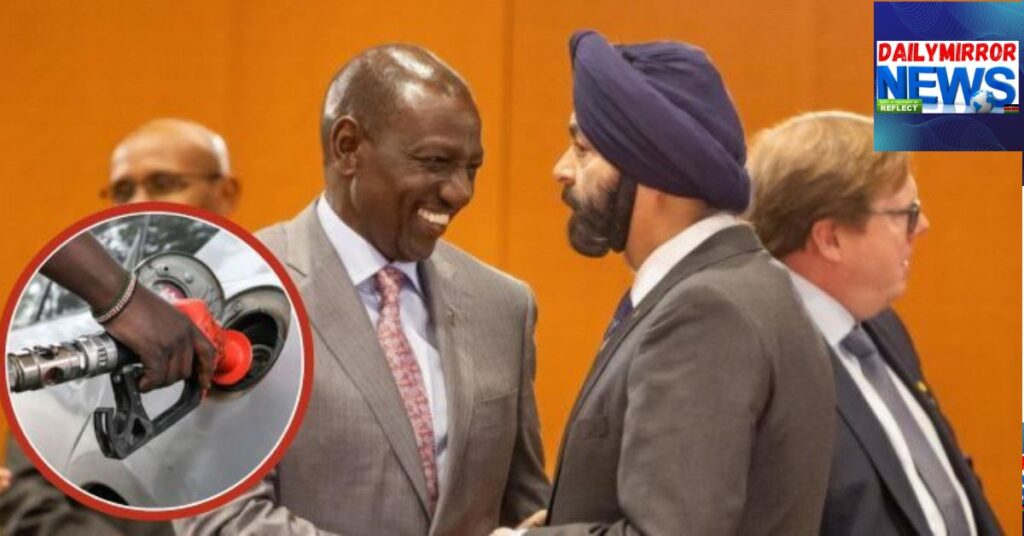
With global markets remaining volatile, the World Bank’s intervention is expected to play a critical role in helping vulnerable countries weather the crisis while longer-term solutions are pursued.
ALSO READ: Gladys Wanga Refutes Claims ODM Can’t Fund NDC Without Edwin Sifuna’s Signature: “Not Mandatory”
World Bank Pledges Financial Aid for Countries Facing Fuel & Fertiliser Shortage Over Middle East War
