


Kenya, South Korea Deepen Digital Partnership in Bid to Transform eCitizen Services
The Kenyan government has launched high-level talks with South Korea aimed at strengthening the country’s digital infrastructure and improving the efficiency of the eCitizen platform as part of its broader Digital Superhighway agenda.
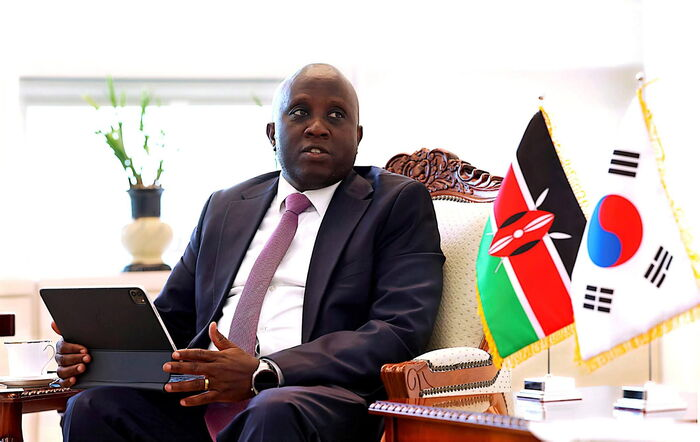
The discussions were held in Seoul on May 6 during a meeting between ICT and Digital Economy Principal Secretary John Kipchumba Tanui and South Korea’s Vice Minister for Interior and Safety Kim Min-jae.
The meeting focused on strengthening cooperation in digital governance, cybersecurity, artificial intelligence, public data management, and interoperable government systems as Kenya accelerates efforts to digitise public services.
Tanui stated, “Korea’s success in establishing a government-wide data-sharing platform offers important lessons for Kenya as we advance our own Digital Superhighway agenda, eCitizen ecosystem, Government Enterprise Architecture and national AI strategy.”

Kenya is increasingly looking to South Korea as a benchmark for modern digital governance due to the Asian nation’s advanced integration of technology into public administration and service delivery.
Officials revealed that South Korea currently manages over 110,000 public data assets and more than 300,000 digital services through highly coordinated systems that allow government agencies to share information seamlessly.
The talks also explored how Kenya can improve coordination between ministries and state agencies through secure digital platforms, reducing delays and duplication in service delivery.
According to the ICT ministry, the proposed collaboration could significantly improve the processing of critical government services such as identification documents, permits, business registration, and licensing applications currently accessed through eCitizen.
Government officials noted, “Better interoperability between agencies will reduce the need for citizens to repeatedly submit the same information across different government offices.”
The discussions come at a time when the Kenyan government is intensifying its push for total digitisation of state services under President William Ruto’s administration.
So far, more than 22,000 government services have already been migrated to the eCitizen platform, with authorities insisting that all public services should eventually be accessible digitally.
The government argues that centralising services through the platform will help improve efficiency, harmonise revenue collection, reduce corruption, and increase transparency in public administration.
However, the rapid digitisation drive has also exposed the country to growing cybersecurity risks.
In November 2025, several government platforms, including eCitizen, were hit by a large-scale cyberattack that temporarily disrupted critical services and raised concerns about the country’s digital preparedness.
The latest talks with South Korea are therefore expected to place major emphasis on strengthening Kenya’s cybersecurity systems and establishing secure frameworks for data protection.
Tanui observed, “Well-structured public data systems, secure digital infrastructure, and practical AI applications are essential in building citizen-centred government services.”
Artificial intelligence adoption was also a major focus during the discussions, with Kenya seeking to explore how AI can be integrated into public administration to improve efficiency and automate key services.
The talks further touched on capacity building and training opportunities for Kenyan professionals in emerging digital technologies.
At the same time, Kenya highlighted ongoing collaboration with South Korea through the Kenya Advanced Institute of Science and Technology project, which is modelled after South Korea’s renowned Korea Advanced Institute of Science and Technology.
The institute is expected to strengthen Kenya’s research capacity in science, technology, engineering, and mathematics while supporting innovation and industrial growth.
The PS pointed to the Kenya Advanced Institute of Science and Technology (Kenya-AIST) as a key outcome of cooperation between the two countries.
Tanui said that progress toward an upcoming charter award to support STEM research at Kenya-AIST, modelled after the Korea Advanced Institute of Science and Technology (KAIST), was also made during the visit.
Tanui revealed that progress had also been made toward securing an upcoming charter award for Kenya-AIST during the Seoul visit.
Analysts say the growing partnership between Kenya and South Korea reflects Nairobi’s ambitions to position itself as a leading digital economy in Africa through technology-driven governance reforms.
ALSO READ:
Kenya, South Korea Deepen Digital Partnership in Bid to Transform eCitizen Services
