



Ruto Blasts Judiciary in Front of CJ Koome, Criticizes Rulings Against His Projects
President William Ruto has openly criticised the Judiciary over a series of court rulings that have stalled or overturned key government programmes, warning that some decisions undermine the policy mandate granted to his administration by voters in the 2022 General Elections.
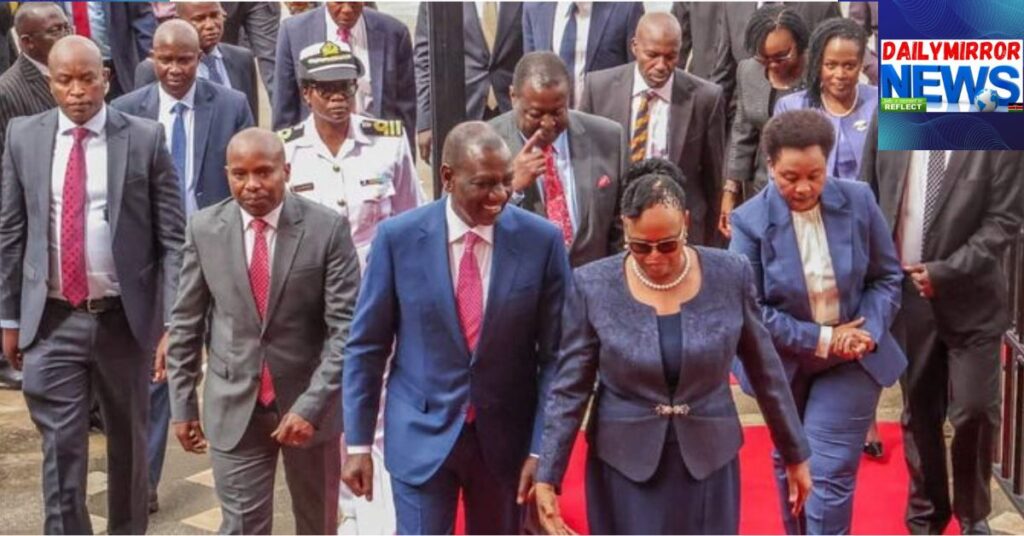
Speaking on Wednesday at State House, Nairobi, during the swearing-in ceremony of newly appointed Court of Appeal judges, President Ruto made the remarks in the presence of senior judicial leaders, including Chief Justice Martha Koome and Deputy Chief Justice Philomena Mwilu. The address marked one of the President’s most direct critiques of the courts in a formal state function.
Ruto argued that several judicial decisions have had far-reaching consequences on government priorities and the lives of ordinary Kenyans. “I have been candid about this reality and, on several occasions, questioned judicial decisions that appear to hinder critical public policy,” the President said. “Some rulings seem to cross into the realms of judicial overreach, or even, as some say, tyranny.”

While acknowledging the constitutional independence of the Judiciary, Ruto dismissed claims that his administration has ignored court orders. He maintained that the Executive has consistently complied with judicial directives, even when rulings frustrate government plans.
“We have obeyed court orders, even when we disagree with them, because that is what the Constitution demands,” he said, adding that concerns raised by the Executive should not be interpreted as defiance of the rule of law.
The President revealed that his administration is considering formally seeking judicial guidance on the legal status of policies derived from political party manifestos. According to Ruto, this would help clarify whether voter-endorsed programmes can be halted through litigation.

“I want to understand when the people vote for a manifesto, which is endorsed as a policy document, where that manifesto stands when implementation is challenged, sometimes to the detriment of millions who voted for it,” he stated. “I will be respectfully approaching the courts to help us understand so that if the manifesto is not important, we stop wasting time with it.”
Ruto’s remarks come against the backdrop of several recent court decisions that have dealt legal setbacks to his administration. Most recently, the High Court declared unconstitutional the appointment of 21 presidential advisors made in 2025. In his ruling, Justice Bahati Mwamuye issued injunctions barring the government from paying salaries or benefits to the advisors.
The court found that the appointments were made without consultation with the Salaries and Remuneration Commission (SRC), which is constitutionally mandated to assess the financial implications of public appointments. As a result, all 21 advisors were ordered to cease holding office immediately.
In December last year, the High Court also temporarily halted the implementation of the National Infrastructure Fund following a constitutional petition challenging its legality. Petitioners, including Dr Margaret Gikenyi, J. Benjamin, Eliud Matindi, and others, argued that the fund violated constitutional provisions on public finance and taxation.
Earlier, in November, the court nullified a set of Executive Orders issued by President Ruto that sought to overhaul recruitment processes in state corporations. The orders had required state agencies to seek approval from the Cabinet Secretary and the State Corporations Advisory Committee for staff recruitment, transfers, and terms of service.
The Law Society of Kenya (LSK) challenged the directives, arguing they undermined the Public Service Commission’s constitutional mandate under Article 234 and opened the door to political interference in public sector hiring.
Despite the mounting legal hurdles, President Ruto insisted that his administration remains committed to implementing its development agenda within constitutional limits, even as tensions between the Executive and Judiciary continue to shape Kenya’s governance debate.
ALSO READ: Ruto–Raila Deal Expires in March, Winnie Odinga Reveals Amid UDA–ODM Talks
Ruto Blasts Judiciary in Front of CJ Koome, Criticizes Rulings Against His Projects
